In recent months, financial analysts and Nigerian citizens have focused on Enugu State’s aggressive economic reforms. Governor Peter Mbah’s administration set a high bar, promising to grow the state’s economy seven-fold. As we enter early 2026, the data for the 2024–2025 fiscal years is finally in.
Here is the fact-check on Enugu’s IGR surge.
1. The Data: Did IGR Actually Increase?
The short answer is yes, significantly. According to the National Bureau of Statistics (NBS) and independent fiscal watchdogs like BudgIT, Enugu State recorded the most dramatic revenue growth in Nigeria over the last two years.
| Metric | 2023 Fiscal Year | 2024 Fiscal Year | 2025 (Projected/Interim) |
| Annual IGR | ₦37.4 Billion | ₦180.5 Billion | ₦500 Billion+ (Target) |
| National Rank | 12th–14th | 5th Overall | TBD |
| Regional Rank | 2nd (South East) | 1st (South East) | 1st (South East) |
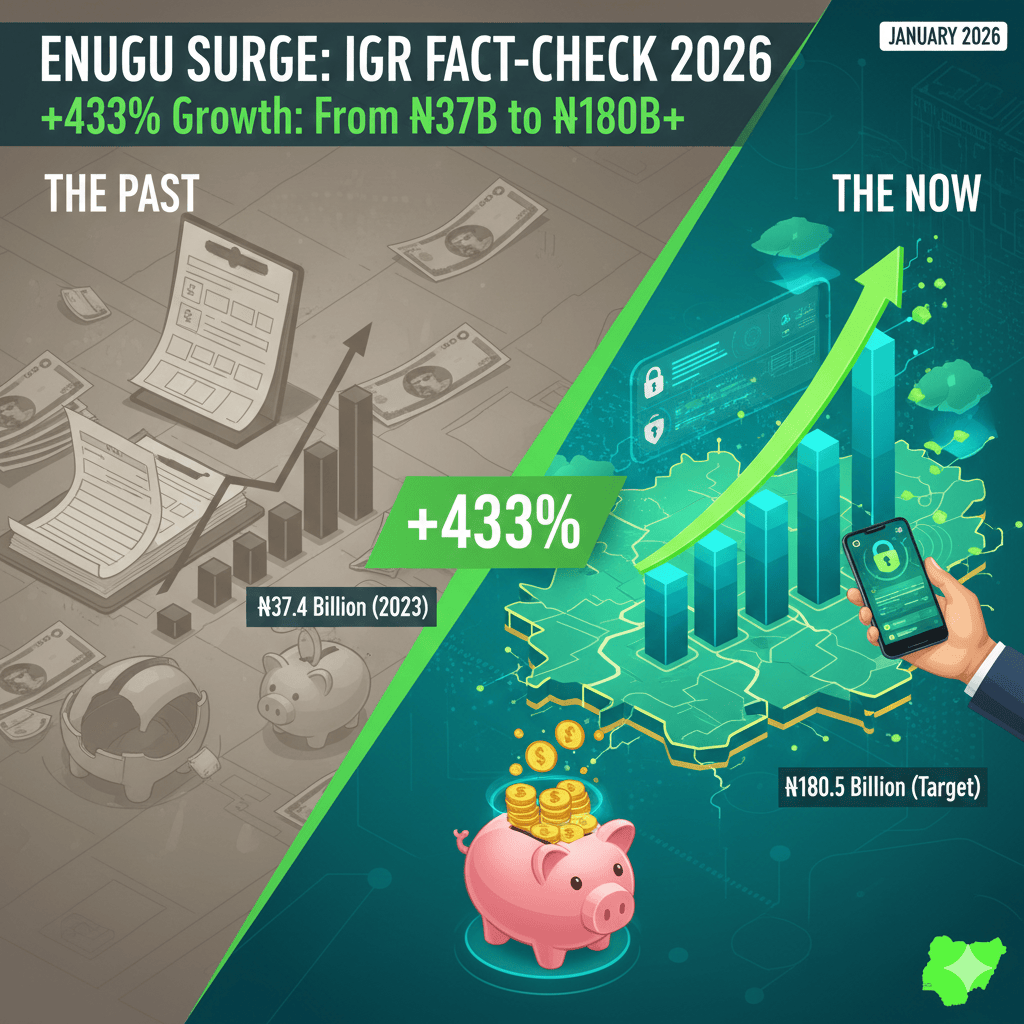
Fact-Check: Official NBS reports from late 2025 confirm that Enugu’s IGR grew by 433% in a single year (2023 to 2024), moving from approximately ₦37 billion to over ₦180 billion.
2. Official Statements vs. Verified Reality
Claim: “Enugu is now the 5th highest revenue generator in Nigeria.”
- Status: VERIFIED.
- Context: For the first time in the state’s history, Enugu surpassed traditional high-earners like Delta and Edo. As of October 2025, only Lagos, Rivers, the FCT, and Ogun State generated more internal revenue than Enugu.
Claim: “The increase was achieved without raising tax rates.”
- Status: PARTIALLY VERIFIED.
- Context: While the government insists it did not increase “tax rates,” it significantly expanded the tax net and improved collection efficiency. This was done by:
- Eliminating Manual Collection: Moving all payments to digital e-governance platforms (over 111 MDAs migrated).
- Land Use Charge: Aggressive enforcement of land-related charges contributed a massive portion of the new revenue.
- Blocking Leakages: Digitization reduced the “middlemen” who previously diverted cash collections.
Claim: “Enugu can now survive without Federal Allocations (FAAC).”
- Status: MOSTLY VERIFIED (Sustainability Index).
- Context: The 2025 BudgIT “State of the States” Report ranked Enugu as the most viable state in Nigeria for fiscal autonomy. Its “Index A” score of 0.68 indicates that 68% of its IGR can now cover its entire operating expenses—making it less dependent on oil money from Abuja than almost any other state, including Lagos (which has higher overheads).
3. Where Is the Money Coming From?
The leap from ₦37 billion to ₦180 billion in 12 months sparked skepticism. However, official statistics attribute the bulk of the growth to:
- Tech-Enabled Tax Administration: The Enugu State Internal Revenue Service (ESIRS) deployed automated tracking.
- Property & Land Assets: The “New Enugu City” project and updated land registries allowed the state to monetize real estate assets.
- Formalizing the Informal Sector: Bringing thousands of previously untaxed businesses into the digital payment system.
The Verdict
The claim that Enugu State increased its IGR is True and Factually Supported by the NBS, BudgIT, and State Budget Performance Reports. The state has transitioned from a civil-servant economy to a top-tier revenue generator.
However, the “stretch goal” of ₦509 billion – ₦600 billion for the 2025/2026 period remains an ambitious target that relies heavily on the continued sale and lease of land in the “New Enugu City” project.